Showing posts with label Pitt Rivers Museum. Show all posts

Tuesday, 31 October 2017

An Amuletic Autumn at Pitt Rivers Museum

It's been a highly amuletic time at the Pitt Rivers recently. The charm, amulet and talisman collections are one of the most significant, evocative and numerous in the Museum's care and they have been the focus of three very different aspects of staff work in October....

1) First, came the invite from BBC Radio 4 to contribute to a series called The Digital Human, exploring the impact of technology on our lives. Aware of the expansive amulet collection at the Pitt Rivers and our various resources, the producers got in touch for an interview contribution to an episode on 'Protection' to reference some of our historical collections within a wider discussion about how smartphones act as modern-day protective amulets. You can listen to the episode here (specific PRM section from 12:00 - 18:00 minutes):


Marc Ferrez. Negra da Bahia, c. 1885 
© Salvador, BA / Acervo IMS 
Source: http://brasilianafotografica.bn.br


Indeed, there are plenty of parallels. We hold phones close to our body, we charge them every night with electricity, the way amulets get charged with personal proximity and powers of belief. We use phones for protection - against being late, against boredom, against laziness (how many steps have you done today?), against crime, against being disconnected from the world. 

Composite charms act like a collection of apps. The balangandan (or penca) from the Bahia region of Brazil is the perfect example. A fusion of cultural influences, this metal ornament came to South America via the West African slave trade in the 17th and 18th centuries and was often worn by female slaves, dangling and jangling from the waist (hence the onomatopoetic name). As a colonial artefact this object is both problematic and challenging but its function is highly relatable; no two balangandans are the same and - just like the apps you choose to download on your phone - they feature various charms deemed relevant and personal to the wearer's life path - perhaps a boat to represent passage across the Atlantic; a fish in a nod to the Christian beliefs of the Portuguese colonial powers; a pomegranate representing fertility inherited from ancient Middle Eastern beliefs; a cashew nut symbolising the candomblé (Afro-Brazilian) god of thunder and lightning; or keys against the Evil Eye.


Balangandan charm, Brazil; 1954.7.15.1

2) October half term is one of the busiest and most hectic weeks of the year for us. Nearly 14,000 people through the doors, many on holiday and looking for some family fun. Being so close to Halloween, we teamed up with the Museum of Natural History next door to offer a 'Bats, Cats, Witches and Charms' extravaganza. They did the Bats and Cats, we did the Witches and Charms. It works :)

Over three days nearly 300 children plus their parents and carers took part in activities such as designing and making their own amulets, working out if witches are who we think they are, and using investigation skills to figure out two truths and a lie about charms in the handling collection. For example, if someone found this object in your garden and told you:
  • It used to be a fish
  • It was fired from a crossbow
  • It protects against lightning
Which one is the lie?

Belemnite, Oxfordshire 2013.23.1 © Pitt Rivers Museum

Did you guess correctly? It's the second one. It might look like a projectile but this is in fact a belemnite - the naturally occurring fossil stone of a now-extinct cuttlefish. Due to their shape, people thought they were the heads of lightning bolts fallen to earth and, since lightning doesn't strike the same place twice, they were often put in the attic of the home to protect against lightning! Incidentally, they were also used for medicinal purposes - in southern England, they were ground to powder and used to cure diseases of the mouth.

What do these charms do? © Pitt Rivers Museum

Charms bring luck, amulets bring protection and talismans attract certain qualities or virtues. The children got wonderfully creative, making talismans to attract tickle monsters, tranquility, or allow the wearer to talk to cats, as well as amulets to protect against negative events such as being sad, dinosaur attacks and forest fires. What worked best about the activities is that the participants had to use their imaginations - often collectively as a family - to work out what it was they wanted (or needed) protection from. The activities employed effective 'visual thinking' strategies (e.g. cultivating curiosity, truth-seeking or creativity) to engage learners - for example, choosing to use handling objects from Europe helped ensure children understood and self-reflected that the use of charms happens in the UK and in nearby countries as well as more globally.

Handwritten labels accompanying the charms families created © Pitt Rivers Museum


3) Lastly, behind the scenes, the Move Project team are dealing with a numbers game. The Museum houses more than 20,000 objects which are documented as amulets. Just under 4,000 are either on display or stored at the Museum, and the remaining 16,000 are kept in reserve collections in storage. Since most amulets are personal items - kept in a pocket, strung around the neck or held in the hand - they are some of the smallest objects here. The Museum is in the process of moving its largest object store to a new building. You can keep up to date with the move via the team's entertaining Twitter feed.

The move involves transporting the 16,000 stored amulets to a new home. The store houses over 100,000 objects, from these tiny amulets to five-metre-long ploughs and almost everything in between. Unless the location of every object is carefully recorded, there is a huge risk that objects can easily become lost - and trying to find an amulet amongst 100,000 other objects is much harder than finding a plough...

To make sure this doesn't happen, members of the Move Team have been busily documenting the collection at the store. Each amulet is being physically numbered with a unique accession number which links to our object database. So far we are making headway with the Blackman collection of amulets, one of several large tranches of amulets transferred from the Wellcome Historical Medical Museum in the 1980s. 

Measuring and labelling an amulet © Pitt Rivers Museum


Each object is photographed and extra information such as a physical description, materials, measurements and any potential hazards are added to the database record prior to packing the object ready for its move. The location of each amulet is also recorded, so we know which box it is in and which shelf that box is on, so if anyone wants to find it we don't have to start looking amongst the ploughs...


Helen Adams, Project Curator and Engagement Officer

with contributions from:

Andrew Hughes, Deputy Head of Conservation
Beth McDougall, Families and Communities Officer


For more about balangandan charms see:
  • Crowley, Daniel J. & Doran H. Ross, ‘The Bahian Market in African-Influenced Art’, African Arts 15:1 (1981), p.p. 56–88 
  • Fözy, Vilma, Balangandan - Afro-brazilian Amulet, Museum of Ethnography, Budapest (March 2016) http://bit.ly/2zTTK39


Thursday, 25 February 2016

Estella Louisa Michaela Canziani (1887-1964)

Estella Canziani is renowned as a folklorist, artist and writer, particularly in relation to her work in Italy. Birmingham Museum & Art Gallery have a web page about Canziani as an artist with images of her tempera paintings, and the Folklore Society have recently published a page about her life and her work with the 'Pearlies' of London.

1941.8.017 Wood pipe donated by Canziani
Canziani was a major collector of European material in the first half of the twentieth century, and a frequent donor to the Pitt Rivers Museum. She contributed over 700 English objects to the museum on eleven different occasions between 1933 and the final bequest following her death in 1964 (though she began sending Alpine objects to the museum in 1914 and contributed to the museum's worldwide collections on over twenty occasions). In 1963 she appointed Beatrice Blackwood as an executor and trustee, noting that 'apart from any of the desirable qualities, & including these qualities - that it would be best, also to have a woman.'
1961.1.089  Vinaigrette donated by Canziani [open]
1961.1.089 Vinaigrette donated by Canziani [open]
This comment suggests that gender had some importance for Canziani, and her donations are part of those that contribute to an increase in contributions by women to the museum's collections in the mid-twentieth century (see page noting this). Canziani seems to have formed part of a network of female traveller-folklorists, often connected through the Folklore Society (FLS). Blackwood and Canziani served together on the council of the FLS and Canziani's 1963 letter asking Blackwood to act as her trustee suggests she does not need to reply as they will meet at 'Council' on the 11th.

This article extract is from England: The Other Within - Analysing the English Collections at the Pitt Rivers Museum project website.

Chris Wingfield,
Researcher


Wednesday, 23 December 2015

Christmas Related Artefacts

The Pitt Rivers Museum's English collections do not have many objects specifically related to Christmas. This is perhaps surprising as this season is perhaps the season most widely celebrated throughout England even today. Indeed English, European and North American Christmas traditions have now spread throughout the world, and can be seen as almost divorced from its purpoted religious connections to Christianity. Christmas Day, 25 December in the Anglican and Roman Catholic calendar, was supposed to be the day when Jesus was born in Bethlehem. It has been a public holiday in the United Kingdom for a very long time, in the nineteenth century it was one of only two days on which workers had a statutory right to be absent under the Factory Act of 1833 (the other was Good Friday)[David please link Good Friday to the Good Friday part of the Easter object biography]. [Hutton, 1996:112]
Hutton makes the point that a midwinter festival had probably been celebrated in Britain from 'the dawn of history'. [1996:34] Christmas, in England, occurs at the darkest time of the year, when days are at their shortest. It is also during the cold winter, when food would have been more scarse and life (before the twentieth century) much harder for most people. As Hutton remarks, 'the Christmas season is the most important complex of festivals in the modern British year and contains by far the largest number of customary practices. [1996:112]

Gifts

1945.6.124 Desk presented to Miss S.U. Powys
Christmas time is a time for exchanging or giving presents to family and friends. Gifts are sometimes also given to employees, or employers or people to whom the person feels an obligation. The next object, which is Christmas-related, is an oddity, it is described as:
'A hideous [sic] fitted desk, 1 ft 2 inches x 10 inches x 9 inches, veneered with bird's eye maple and with brass ornaments, and an inscription on brass: "Presented to Miss S.U. Powys by the members of the Bournemouth Central Workers' Club, Christmas 1877". Tout à fait typique.'[1945.6.124]
It was donated by William Horace Boscawen Somerset in June 1945. It is not known why Bournemouth Central Workers Club felt it should give Miss Powell the desk at Christmas, or why the anonymous accession book recorder in 1945 should feel that the desk was so 'hideous', though there is a rather unattractive underlying note of snobbishness in the final sentence 'tout à fait typique' (loosely translated as 'entirely typical'). This object was not given to the Museum because it was a Christmas gift (indeed the motivation for giving it to the Museum or accepting it seems unclear as it was considered so 'hideous'). The museum has been unable to find out anything more about either Miss Powell or the Bournemouth Central Workers Club and would be grateful for any information on either.
Gift-giving, before the nineteenth century, had traditionally been associated with New Year rather than Christmas Day but during that century, the date gradually changed to Christmas Day, where it has remained. [Hutton, 1996:116] As Hutton points out, dislike of the perceived commercial nature of Christmas started early, 'George Bernard Shaw started an enduring myth in 1897 by declaring that 'Christmas is forced upon a reluctant and disgusted nation by the shopkeepers and the press'.' [1996:116]

This article extract is from England: The Other Within - Analysing the English Collections at the Pitt Rivers Museum project website.

Alison Petch, 

Researcher


Friday, 4 December 2015

Topping-out at the Pitt Rivers Museum

On 24 February 2006 Dr John Hood, the Vice-Chancellor of the University of Oxford, donated a ceremonial trowel and tankard in presentation boxes to the Pitt Rivers Museum [PRM]. 

The topping out ceremony, John Hood receives his ceremonial trowel


These gifts had been given to him on 9 February 2006 during the topping-out ceremony for the new extension to the PRM. The photographs on this page show the extension being built, the ceremony itself and the subject of this biography, the ceremonial trowel. John Hood is wearing a brown coat in the photographs, and the bearded man is Michael O'Hanlon, director of the museum. Other men are representatives of the builders, Sir Robert McAlpine.

Topping-out ceremonies


Topping-out is a ceremony traditionally held when the last beam is placed at the top of a building, or these days, the last iron beam. The ceremony marks the overall completion of the building's structure (the building is not completed, or ready for transfer to the owners or clients, it is a stage during the building process). According to wikipedia, such ceremonies are common in England, Germany, Poland and the United States.
2006.78.1 Ceremonial trowel given to John Hood at the PRM topping-out ceremony
A tree or leafy branch is placed on the topmost beam, often with flags or streamers tied to it. A toast is usually drunk and sometimes the workmen are treated to a meal.' [http://en.wikipedia.org/wiki/Topping_out]
According to Simpson and Roud [2000, see "building trade" in further reading list below for source]:
What passes for building trade lore nowadays are ‘official’ customs such as cutting the first turf, laying a foundation stone, and topping out. The latter has been particularly popular since the 1960s, and few major construction projects are completed without a gathering of company officials, local dignitaries, and newspaper photographers on top of the new building to perform some ceremony such as laying the last brick. This custom has some roots, as there are earlier references to the workers hoisting a bush, or a flag, to the roof of a completed building.
This article extract is from England: The Other Within - Analysing the English Collections at the Pitt Rivers Museum project website.

Alison Petch, 

Researcher


Monday, 16 November 2015

A Dorset Hag Stone

1884.56.3 is an object, described by a museum worker as a 'stone with natural perforation, found fixed on a nail to the cottage-door of Kimber, a carter in General Pitt Rivers' employment, to keep away witches'. This is particularly interesting as it must have been acquired between 1880, when Pitt Rivers first inherited the Rushmore estate, and 5 April 1881 when he sent the stone to South Kensington Museum (where his collection was then displayed).
PRM 1884.56.3


The documentation held at the Museum states:
Accession Book IV entry - 1884.56.1 - 100 Charms Magic etc. - Naturally perforated stone, nailed to a cottage door against witches by a carter Rushmore nr Salisbury
'Green book' entry - South Kensington Receipts, 5 April 1881 - Collection of objects as per list attached nos 293 to 639 540 Holed stone used for the purpose of keeping away witches Rushmore nr Salisbury

Detailed Amulet card catalogue entry - Amulets ) O. Inscribed P. Talismans in cases Q Uninscribed single R Collars, necklets, armlets, rings S-T Juju [sic] U-W Stone X. Dance Y. Unclassed. - Naturally perforated stones Gt Britain Description: Stone with natural perforation, found fixed on a nail to the cottage-door of Kimber, a carter in Gen'l Pitt Rivers' employment, to keep away witches. Dimensions 100 x 64 approx Locality: Rushmore nr Salisbury How Acquired: P.R. coll 540 / 12191
The original documentation does not mention the name of the carter and it is not clear where the information came from, it first appears in the Ettlinger account, she thanks the then curator of the Museum, Tom Penniman, for information so he may have given her the reference, it is irritating that it was not recorded where it was obtained, as that source might have more information about the artefact.

This article extract is from England: The Other Within - Analysing the English Collections at the Pitt Rivers Museum project website.

Alison Petch, 

Researcher

Thursday, 10 September 2015

Votive Rags from St Helen's Well, Thorp Arch near Boston Spa, West Yorkshire


Rag Strip 1884.140.331 .1
1884.140.331 is an example of the votive rags that were tied to a tree near a well. Oddly this item was not accessioned into the Pitt Rivers Museum collections until the 1990s though it had lain in the museum for over a hundred years by then.


The documentation the Museum has about these objects is as follows:
1884.140.331 Blue book entry - Idols and objects connected with religion Case 78 159 Fragments of rag used as votive offerings for the cure of diseases at St Helens Well Thorp Arch Yorkshire at the present time (2496)
Delivery Catalogue II entry - Religious emblems Votive rags on card 2496 13 Cases 225 226
Detailed Amulet card catalogue entry - Amulets D. Crop Fertility, E. Offerings to Gods etc F. Spirit Houses, Scares G. Sacred and Mem. food H. Relics and Mementos - Models of human body E3 Ex voto rags, pins etc Description: Votive rags from bushes at a holy well hung there by the country people who believe the water is good for eye diseases [insert] if [end insert] combined with an offering of this type to St Helen. They are often left by Roman Catholics being near Clifford where they are numerous Locality: St Helen's Well Thorp Church Yorks Collected by: Mrs Marianne Cooke 1869 How Acquired: PR coll 159 dd Mrs M. Cooke 1869 [sic]
This well was just off the Roman road, the Rudgate. This well was supposed to be devoted to St Helen. The site of the well is actually at Thorp Arch, outside Boston Spa near Wetherby in North Yorkshire. Ellen Ettlinger mentions the rags:

In pre-Christian days, when wells and trees were identified with spirits, offerings were deposited in their immediate neighbourhood to preserve the contact between the worshipper and the divinity. Since the spread of Christianity the real intention of this rite has been preserved only at those wells, where Christian Saints replaced the well spirit. 
This article extract is from England: The Other Within - Analysing the English Collections at the Pitt Rivers Museum project website.

Alison Petch, 

Researcher

Tuesday, 18 August 2015

A Fisherman’s ‘Lucky stone’ from Newbiggin-by-the-Sea, Northumberland

PRM 1908.11.1


Introduction

At the front of the Sympathetic Magic display at the Pitt Rivers Museum, case 61a, is a perforated black limestone beach pebble with a string attached through the hole. [1908.11.1] The museum’s accession book states that this is a “Beach pebble of black limestone bored by pholas, hung behind a door in the cottage of William Twizel, fisherman, as a “lucky stone”.’ (Humble, 1908). Apparently several of these stones hung by various doors of the cottage. The stone comes from Newbiggin-by-the-Sea, Northumberland, and was donated in 1908 by a Miss Humble, Alexander James Montgomerie Bell, and William Twizel (actually Twizzell) in 1908.
There is no mention of a William Twizel in the 1901 census. However, there several William Twizzells (various spellings) in Newbiggin, one being born in 1822 and who died a retired fisherman in 1913. The most likely donor is a William Twizzell who was born circa 1829/1830 and who died a retired fisherman in 1909.

The Donors

Miss Humble is described as a field collector but little else is known about her. Accession records in the PRM say she was a resident of Newbiggin. However, the name is fairly common in the north-east and it was not possible to identify her in either the 1891 or 1901 censuses (england.prm.ox.ac.uk/collector).

Much more is known about Alexander James Montgomerie Bell. Born in Edinburgh in 1846 he was an undergraduate at Balliol and matriculated as an Exhibitioner in 1864, gained his BA in 1869 and took his MA in 1871 (Oxford University Alumni 1500-1886). The obituary of Bell describes him as a career academic, teacher, antiquarian, and amateur archaeologist. He worked sometimes as a tutor and had more formal roles as a schoolmaster (Marlborough, Fettes) and college lecturer and examiner (St Johns, Worcester). Alexander Bell was also known for his work and research on the Wolvercote gravels and deposits near Oxford (Nature, 1920). He died in 1920 aged 74 and his artefact collection was sold to the Pitt Rivers Museum. Alexander Bell lived in 1891 with his wife Anna and children Archibald, Evelyn, Mary, and William at Rawlinson Road in Oxford. At this period he was engaged in private tutoring in classics, geography and geology (RG12a. 1166. 87.). The family was still there in 1901 when Alexander held a position of private tutor at a public school (RG13. 1381. 35.). Indeed, Alexander’s son Archibald Colquhoun Bell (born 1886), and who had a long naval career, also became a donor to the PRM around 1920 (england.prm.ox.ac.uk/collector).

The folklore of holed stones

The Newbiggin stone “…a pebble of black limestone, bored by a pholas, was hung behind the door of William Twizel’s cottage…” (Ettlinger, 1943). Such holed stones were “…evidently regarded as magical as early as the second millennium B.C., as shown by the excavations at Tell el Ajjul (ancient Gaza)…” (Murray, 1943). As such these stones were deliberately placed with three in a room and one in a grave.

The hole in the Newbiggin stone was made by a burrowing bivalve mollusc called Pholas dactylus. Also known as the ‘Common Piddock’ or ‘angelwing’ it is similar to a clam and bores into a range of soft rock sub-strata including chalk, peat, clay, and sandstone. This elliptical shaped boring bivalve, which can reach 12cm in length, is found at several sites along the east coasts of Northumbria and Yorkshire. It stays in its burrow for its entire eight-year life-span, it is recognised by its typical whitish colouration and is also known for its bio-luminescence.
This article extract is from England: The Other Within - Analysing the English Collections at the Pitt Rivers Museum project website.

Eric Edwards


Friday, 7 August 2015

A Loop of Rowan Tree: amulets against witchcraft


A Loop of Rowan Tree - 1893.18.1
On February 28, 1893, three loops of rowan tree were donated to the Pitt Rivers Museum by Rev. Canon John Christopher Atkinson, from Danby Parsonage, Grosmont, York. (Accession Nos. 1893.18.1-3) These are now on display in Case 31.A - Magic, Witchcraft and Trial by Ordeal, located in the Court of the Museum. The records describe the rowan loops as amulets against witchcraft, but they also appear to have been prophylactic against ghosts, fairies, spirits, and the Evil Eye. All three loops are of different size, one of them measuring 70 mm at its maximum length (1893.18.1). Their provenance is stated alternatively as "England, North Yorkshire, Grosmont [Esk Valley]" and "England, North Yorkshire, Grosmont, Castleton."


Rowan trees


The European rowan (Sorbus aucuparia) has long been associated with magic and protection against enchantment and evil beings in Europe. [10]
This tradition allegedly goes back at least to Greek mythology. We are told that Hebe, the goddess of youth, in a moment of carelessness lost her magical chalice to the demons. Having thus been deprived of their source of rejuvenating ambrosia, the gods decided to send an eagle to recuperate the cup. In the fight that stood between eagle and demons, some of the eagle's feathers fell to the earth together with a few drops of blood. There they became rowan trees. The feathers took the shape of leaves; the drops of blood that of the rowan's red berries. [7]
In Norse mythology, the first woman (Embla) is said to have been made from rowan tree. The rowan also figures in the Æsir story of Thor's journey to the Underworld, in which Thor, after having fallen into a rapid river, is rescued by a rowan tree that bends over and helps him back onto the shore. [7]
Some of the rowan tree's magic and protective qualities may stem from the fact that there is a small five-pointed star, or pentagram, opposite the stalk of each berry; pentagrams have long been considered symbols of protection. The berries' red colour is also claimed to be the best protective colour against enchantment. Linguists say that the name 'rowan' might derive from the Old Norse raun or rogn, which could have its roots in the proto-Germanic *raudnian, 'getting red'. However, druids would use both the berries and the bark of the rowan tree for dyeing the garments that they wore at lunar ceremonies black. [7] [10]
This article extract is from England: The Other Within - Analysing the English Collections at the Pitt Rivers Museum project website.

Sandra Modh,
Harris Manchester College

Saturday, 25 July 2015

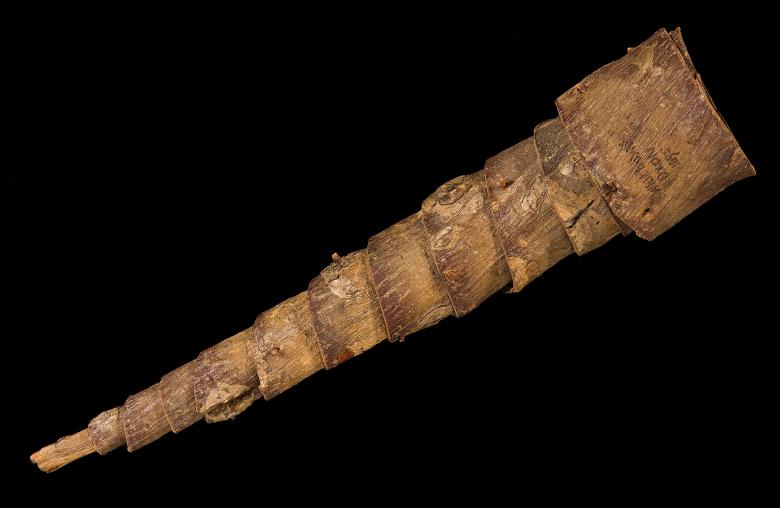
The Whit-Horn

1895.21.1 Whit-horn of willowbark, primitive oboe
In the first half of the nineteenth century it was traditional for the Oxfordshire villages of Hailey, Crawley and Witney to celebrate Whit Monday with a hunt at Wychwood Forest. Whit-horns were made of softened willow bark in the weeks leading up to the celebrations, and played at dawn to wake the village for the hunt.
Formed from strips of willow bark wound into a funnel, the horns were secured with hawthorn or blackthorn spines, the whole measuring around 18" in length and 4" across the bell. Bark was inserted into the narrow end to form a reed, with the mouthpiece pinched together around it, hence Henry Balfour, the first Curator of the Pitt Rivers Collection, described the entire as a 'primitive oboe'.
Describing the traditions surrounding the Whit hunt in Oxfordshire, Balfour wrote,
In accordance with an old charter, certain villages in Oxfordshire were allowed on Whit-Monday to kill a stag in the forest preserves [and feast on their prey. Prior to this, young people] were busy preparing rude instruments of music (or rather of noise), with which to call the villagers to the hunt... they ran round the villages waking people up with the sound of their "whit-horns," as they were called. [1896:221]
The whit-horns in the Pitt Rivers collection (1895.21.1, 1903.130.22.1 and 1903.130.22.2) were donated by Henry Balfour, but were collected by Thomas Carter. They were made in the 1890s - half a century after the last Whit hunt (at the enclosure of the forests). Their maker was an anonymous local man, who had made similar instruments for the hunt in his youth. Percy Manning, a contemporary and probably acquaintance of Balfour's, also collected a whit-horn, which was made for him by John Fisher in 1895. It is likely that he shared his contacts with Balfour and that Balfour's instruments were made by the same man.


This article extract is from England: The Other Within - Analysing the English Collections at the Pitt Rivers Museum project website.
Alice Little

Tuesday, 19 May 2015

French Connection: Amulet loan to Marseille

The Pitt Rivers Museum often loans objects to other museums, both in the UK and abroad. During transit, installation and removal, a member of Pitt Rivers Museum staff is present making sure the objects are looked after. The Musée des Civilisations de l’Europe et de la Méditerranée (MuCEM) in Marseille has a temporary exhibition entitled Lieux Saints Partagés ('Shared Sacred Sites'). Staff from MuCEM came to the PRM to select candidates objects in summer 2014 and earlier this month I couriered the loan of 14 amulets to Marseille.


MuCEM © Pitt Rivers Museum

The amulets were checked and prepared by Kate Jackson, Conservator at the PRM. Kate took photographs and recorded the condition of the objects before their journey, then mounts were made to keep the fragile object secure in transit as they were packed into a small carry case. I flew to Marseille and the carry case was secured in the aeroplane seat next to me.

The amulets being checked and then installed in the display case. © Pitt Rivers Museum

At MuCEM the other objects and art works of the exhibition were also being installed - objects exploring the nature of holy sites of shared significance among different religions around the Mediterranean.

The loaned amulets derive from Jewish, Christian and Muslim traditions, made in continental Europe, north Africa and the near East. They are all part of a large collection made by Adrien de Mortillet, which was the focus of our recent Small Blessings project.

Twelve of the Pitt Rivers amulets were put in a display case together. The other two were displayed in a case with other objects from the Milk Grotto in Bethlehem. These two circular tablets are made of white clay. One side is impressed with a geometric motif, the other side shows a feint figure of the Virgin Mary holding the baby Jesus.


Milk Grotto tablets, Palestine. PRM 1985.52.938 © Pitt Rivers Museum

According to legend, Mary was nursing baby Jesus in the grotto when a drop of milk spilled onto the ground and turned it white. This miracle led to the belief that dust and clay from the grotto, which is made of limestone, can enhance fertility and improve a motherʼs milk. Although tablets of clay like these ones are no longer sold, the Franciscans who oversee the shrine still prepare small packets of limestone powder to give in return for a small donation. They instruct that both husband and wife should drink the powder mixed with milk or water for nine days, and recite the prayer for the Third Joyful Mystery of the Rosary which recalls the birth of Jesus, known as the Nativity.

Milk Grotto display © Pitt Rivers Museum

MuCEM was built for 2013 when Marseille was European Capital of Culture. Marseille is a historic port city and a modern meeting place for Mediterranean cultures which makes it an entirely appropriate place for an exhibition such as this. The exhibition is on until 31 August 2015.

MuCEM and Fort Saint-Jean. © Pitt Rivers Museum

Madeleine Ding
Curatorial Assistant and Volunteers Officer


Wednesday, 5 February 2014

Cataloguing Hildburgh’s amulets

W. L. Hildburgh. Image: V&A
Walter Leo Hildburgh was a prolific collector of amulets from all over the world. When he died in 1955, he left his collection to the Wellcome Museum, and from there it was transferred in 1985 - along with thousands of other amulets including those collected by Lovett and de Mortillet - to the Pitt Rivers Museum.

The Wellcome Collection in London is currently engaged in a major revamp, and their new Reading Room will have fresh display spaces, for which they want to loan a number of the amulets now in Pitt Rivers. Some of the Wellcome staff visited Oxford recently and made a selection from the Hildburgh, Lovett and de Mortillet collections. While Lovett and de Mortillet have been the subjects of recent documentation projects, much of the Hildburgh collection remains uncatalogued. It was my task therefore, over the course of a three-month project, to ensure that the documentation for the selected objects was up-to-date, and that a digital image was provided for each.

Amulet for animals
© Pitt Rivers Museum, 1985.53.409
I started by completing the documentation of the Japanese section of the collection, which had already been started by two of my colleagues. From 1900, Hildburgh began a prolonged tour of Japan, India and China. He had a keen interest in anthropology and folklore - particularly magic and superstition. Many of the Japanese amulets are papers, printed with inscriptions and sometimes pictures, which you can buy at Shinto shrines and Japanese Buddhist temples. They can be for protection from various aliments, good luck, or for averting a particular calamity. Animals don’t have to go without protection, either: this amulet, from Hase-dera Temple in Kamakura, is for cows and horses.

Other amulets take the form of objects. They can be natural objects which are ascribed magic or amuletic properties, or they can be figures of deities or animals associated with good luck. One of these, the ‘maneki-neko’, the beckoning cat, is well-known outside Japan and can often be seen enticing customers to enter a Japanese restaurant. It does not bring luck exclusively to business owners, but to anyone who owns such a figurine. 

Maneki-neko and pig amulets
© Pitt Rivers Museum 1985.53.696 and 1985.50.154

Around 20 of Hildburgh’s Japanese amulets are going on display at the Wellcome Collection. To these are added some examples from Italy, Tunisia and Algeria. Amulets from these countries are often meant to be carried on the person for protection and double up as ornaments, e.g. pendants and brooches. This mother-of-pearl pig from Italy is a particularly pretty example. In his ‘Notes on Amulets’, Hildburgh writes that the pig stands for tranquility, an easy life and ‘all desired’.

Amulets are a particularly fascinating and pleasing subject. They are usually small, often beautiful, and come from all over the world, with interesting tales behind them. My project was only a very short one, and whilst I was able to complete the documentation of the Japanese section alone, much of Hildburgh’s collection awaits future projects to uncover the rest of its stories.


Elin Bornemann

Friday, 12 April 2013

Art exhibition on amulets and child loss

During the Small Blessings project we received a research visit from artist Marie Brett, who was in the development stage of a project looking at the sensitive subject of amulets as signifiers of pregnancy and infant loss. With support from Arts Council the artist worked with bereaved parents and three national hospitals in Ireland.

Marie also entered our amulet photo competition with this entry:


Now Marie's exhibition is ready. 'Amanesis' will be showing at the Waterford Central Library in Ireland until May 3rd.


Even after the official end of the Small Blessings amulet project, it's great to learn of these ripple effects and additional outcomes that it contributed to. It was a pleasure to meet Marie and we wish her every success with her exhibition and future projects.

Helen

Thursday, 14 February 2013

Hearts in Mind

Ah, February 14th. Will you be sharing heart-shaped cards with your beloved, or sitting alone on the sofa in your pyjamas eating chocolate and settling for heart-throbs on screen? Either way, Valentine's Day is all about hearts and here are two very different ones from our collections:

First up is this Sacred Heart from the de Mortillet amulet collection. What began as a vision by a 17th-century French nun, Marguerite-Marie Alacoque, of Jesus Christ showing her his heart entwined with thorns and flames turned into an active cult of worship in France. There is a Sacred Heart feast day, the symbol was adopted for protection during the French Revolution, and of course there is the famous white church of Sacré-Cœur Basilica at Montmartre in Paris.

PRM 1985.52.33

Next is a rather more gruesome heart object - a preserved human heart in a leaden case, discovered in the medieval crypt of a church in Cork, Ireland and collected by General Pitt Rivers in the 1860s.

PRM 1884.57.18

For an interesting account of the history and significance of heart ablation and burial separate from the body, see this article on one of our project sites. Alternatively, this object features on our gallery audio tour and you can hear the entry here (3 mins):

Wednesday, 5 September 2012

A Charming Send-off

All good things come to an end. Last week the Small Blessings project came to its official close and we saw the departure of both amulets and people from the staff areas of the Museum.

Over the past seven months, more than 3000 objects have been physically numbered, catalogued and photographed. What an achievement! But de Mortillet was no slouch when it came to collecting and there remains a large number of religious 'medals' or tokens that will be processed in due course.

Just a few of de Mortillet's many medals or tokens


Meanwhile, the catalogued amulets have been repackaged and boxed up, ready to return to the stores.

Boxes of amulets in transit to our storage facility 


Originally they were in huge, old-fashioned trunks but with much more economic and organised packing, they are now contained within slimmer archival boxes which take up much less valuable space on our very crowded shelves!

Finding a new home for the amulets


Each amulet has been given a location (a box and shelf number) so will be easy to find should we need to retrieve it for display purposes or a visiting researcher.

We also had to say goodbye to our three contract project staff - Charlotte, Alice and Rosanna. It was a bit of a sad day, despite the copious tea and cake, as they had all become part of the Museum and we will miss them. We wish them well with their future endeavours and hope that they've enjoyed their experience at Pitt Rivers. One thing's for sure - having worked with amulets from around the world to protect against every conceivable disease, misfortune and evil spirit, or designed to bring prosperity, health, fertility and good fortune, there was little need for us to wish them 'good luck'...

A lucky cuppa © The Moon's Hobby Store and More

Helen

Wednesday, 22 August 2012

Vials, Boxes and Envelopes: De Mortillet's Storage System

As we come to the end of the project and the amulets are nearly ready to be put into storage, I thought it would be interesting to reflect on some of de Mortillet's own storage methods and how they differ from those we use in the Museum today. At first glance the containers that he stored some amulets in appear to be utterly random, perhaps things that he simply had lying around his office or house. However, on closer inspection, you begin to ask, 'are they'?

Some amulets have been stored in cardboard pen-nib boxes. For example, this one contained ten discs of bread or ‘small loaves’ with religious figures moulded onto them from Copacabana in Bolivia. You can easily imagine that de Mortillet would have had several pen-nib boxes on his desk. In addition, they are well suited to housing small amulets!


1985.52.1735. 1-.10 © Pitt Rivers Museum 


We've also found a number of amulets inside envelopes, such as this one here, addressed to ‘Monsieur A, de Mortillet’ written in beautiful handwriting and with a wonderful stamp on it. The envelope contains a religious picture made from daisies and wood from the hazel tree where Christ appeared to St. Margaret Mary of Alacoque. Again, it's more than likely that de Mortillet would have had an abundance of old envelops that he could slip amulets into.


1985.52.2693 © Pitt Rivers Museum

However, it's striking how many pharmaceutical or medicinal boxes and glass vials de Mortillet used as storage containers, and I would suggest that this is significant. Many of the amulets in the collection have medicinal qualities and have connections with health issues. Therefore, the choice of these objects to store some of the amulets becomes less random, even though the objects are not directly related to the containers they are stored in. We can only guess at what de Mortillet’s actual intentions were. 

Firstly, lots of objects are stored in glass test tubes, vials or jars. This test tube with a cork stopper contains seven fragments of shell from Algeria. 


1985.52.190 .1-.7 © Pitt Rivers Museum

And this glass 'Grains de Vals' jar contains lead pellets from the Holy Land, yet it would originally have contained herbal medicine for constipation. Grains de Vals have been a used as medicine for a long time (as both the jar and this advertisement from 1934 suggest), and they are still sold today. 


1985.52.2279 © Pitt Rivers Museum
Grains de vals, 1934 (Wikimedia Commons)


Lastly, de Mortillet used various boxes and tins that once contained medicine or cures for various ailments, and which now are very sought after 'vintage' items. For example, there is a cardboard liquorice paste (Pâte de Réglisse) box containing a clay plaque described in the catalogue as a medieval wizard’s talisman. The label translates as: 


'Liquorice Florent. Vanilla flavoured liquorice paste. Delicious tasting, this paste facilitates digestion and expectoration. It cures colds, hoarseness, influenza, stomach upsets and effectively combats ailments of the chest. Made in the great liquorice factory of Cantarel - Avignon (France).'


1985.52.1064 © Pitt Rivers Museum


There is also a ‘Le Rénïol’ metal tin containing eleven iron pyrite crystals. The box would originally have contained pills or small pastilles for a head cold made up by 'PHARMACIE RENGNIEZ, 56 Rue de Passy, Paris'.


1985.52.2337 © Pitt Rivers Museum


We use different packing practices in the Museum today to ensure that objects are stored in a stable environment. The amulets are stored in acid-free boxes, which are lined with jiffy foam (a neutral packing material). Each amulet is placed in it’s own individual sealable plastic bag, which can also be lined with jiffy foam if an object is a little bit fragile. We stack the objects in the boxes with the heaviest items at the bottom, and it’s important not to overfill them. It is essential to label each box and to make a corresponding note about the location of each object on the computer database so that we always know where it is and it can be found easily. 


De Mortillet amulet boxes in the Museum's on-site store room


De Mortillet used a range of containers to house the amulets he collected. They often seem merely random or expedient, but they are incredibly interesting objects in their own right and some are visually very appealing. On one level they provide insight into the type of things, especially pharmaceutical items, common to French households at the time. But on another level, if the use of these medical boxes and glass vials was intentional, perhaps de Mortillet was trying to say something much more significant? Discovering what his intentions were might help us to understand more about his motivations for collecting certain objects. 

Rosanna