Showing posts with label folklore. Show all posts

Thursday, 25 February 2016

Estella Louisa Michaela Canziani (1887-1964)

Estella Canziani is renowned as a folklorist, artist and writer, particularly in relation to her work in Italy. Birmingham Museum & Art Gallery have a web page about Canziani as an artist with images of her tempera paintings, and the Folklore Society have recently published a page about her life and her work with the 'Pearlies' of London.

1941.8.017 Wood pipe donated by Canziani
Canziani was a major collector of European material in the first half of the twentieth century, and a frequent donor to the Pitt Rivers Museum. She contributed over 700 English objects to the museum on eleven different occasions between 1933 and the final bequest following her death in 1964 (though she began sending Alpine objects to the museum in 1914 and contributed to the museum's worldwide collections on over twenty occasions). In 1963 she appointed Beatrice Blackwood as an executor and trustee, noting that 'apart from any of the desirable qualities, & including these qualities - that it would be best, also to have a woman.'
1961.1.089  Vinaigrette donated by Canziani [open]
1961.1.089 Vinaigrette donated by Canziani [open]
This comment suggests that gender had some importance for Canziani, and her donations are part of those that contribute to an increase in contributions by women to the museum's collections in the mid-twentieth century (see page noting this). Canziani seems to have formed part of a network of female traveller-folklorists, often connected through the Folklore Society (FLS). Blackwood and Canziani served together on the council of the FLS and Canziani's 1963 letter asking Blackwood to act as her trustee suggests she does not need to reply as they will meet at 'Council' on the 11th.

This article extract is from England: The Other Within - Analysing the English Collections at the Pitt Rivers Museum project website.

Chris Wingfield,
Researcher


Friday, 4 December 2015

Topping-out at the Pitt Rivers Museum

On 24 February 2006 Dr John Hood, the Vice-Chancellor of the University of Oxford, donated a ceremonial trowel and tankard in presentation boxes to the Pitt Rivers Museum [PRM]. 

The topping out ceremony, John Hood receives his ceremonial trowel


These gifts had been given to him on 9 February 2006 during the topping-out ceremony for the new extension to the PRM. The photographs on this page show the extension being built, the ceremony itself and the subject of this biography, the ceremonial trowel. John Hood is wearing a brown coat in the photographs, and the bearded man is Michael O'Hanlon, director of the museum. Other men are representatives of the builders, Sir Robert McAlpine.

Topping-out ceremonies


Topping-out is a ceremony traditionally held when the last beam is placed at the top of a building, or these days, the last iron beam. The ceremony marks the overall completion of the building's structure (the building is not completed, or ready for transfer to the owners or clients, it is a stage during the building process). According to wikipedia, such ceremonies are common in England, Germany, Poland and the United States.
2006.78.1 Ceremonial trowel given to John Hood at the PRM topping-out ceremony
A tree or leafy branch is placed on the topmost beam, often with flags or streamers tied to it. A toast is usually drunk and sometimes the workmen are treated to a meal.' [http://en.wikipedia.org/wiki/Topping_out]
According to Simpson and Roud [2000, see "building trade" in further reading list below for source]:
What passes for building trade lore nowadays are ‘official’ customs such as cutting the first turf, laying a foundation stone, and topping out. The latter has been particularly popular since the 1960s, and few major construction projects are completed without a gathering of company officials, local dignitaries, and newspaper photographers on top of the new building to perform some ceremony such as laying the last brick. This custom has some roots, as there are earlier references to the workers hoisting a bush, or a flag, to the roof of a completed building.
This article extract is from England: The Other Within - Analysing the English Collections at the Pitt Rivers Museum project website.

Alison Petch, 

Researcher


Tuesday, 18 August 2015

A Fisherman’s ‘Lucky stone’ from Newbiggin-by-the-Sea, Northumberland

PRM 1908.11.1


Introduction

At the front of the Sympathetic Magic display at the Pitt Rivers Museum, case 61a, is a perforated black limestone beach pebble with a string attached through the hole. [1908.11.1] The museum’s accession book states that this is a “Beach pebble of black limestone bored by pholas, hung behind a door in the cottage of William Twizel, fisherman, as a “lucky stone”.’ (Humble, 1908). Apparently several of these stones hung by various doors of the cottage. The stone comes from Newbiggin-by-the-Sea, Northumberland, and was donated in 1908 by a Miss Humble, Alexander James Montgomerie Bell, and William Twizel (actually Twizzell) in 1908.
There is no mention of a William Twizel in the 1901 census. However, there several William Twizzells (various spellings) in Newbiggin, one being born in 1822 and who died a retired fisherman in 1913. The most likely donor is a William Twizzell who was born circa 1829/1830 and who died a retired fisherman in 1909.

The Donors

Miss Humble is described as a field collector but little else is known about her. Accession records in the PRM say she was a resident of Newbiggin. However, the name is fairly common in the north-east and it was not possible to identify her in either the 1891 or 1901 censuses (england.prm.ox.ac.uk/collector).

Much more is known about Alexander James Montgomerie Bell. Born in Edinburgh in 1846 he was an undergraduate at Balliol and matriculated as an Exhibitioner in 1864, gained his BA in 1869 and took his MA in 1871 (Oxford University Alumni 1500-1886). The obituary of Bell describes him as a career academic, teacher, antiquarian, and amateur archaeologist. He worked sometimes as a tutor and had more formal roles as a schoolmaster (Marlborough, Fettes) and college lecturer and examiner (St Johns, Worcester). Alexander Bell was also known for his work and research on the Wolvercote gravels and deposits near Oxford (Nature, 1920). He died in 1920 aged 74 and his artefact collection was sold to the Pitt Rivers Museum. Alexander Bell lived in 1891 with his wife Anna and children Archibald, Evelyn, Mary, and William at Rawlinson Road in Oxford. At this period he was engaged in private tutoring in classics, geography and geology (RG12a. 1166. 87.). The family was still there in 1901 when Alexander held a position of private tutor at a public school (RG13. 1381. 35.). Indeed, Alexander’s son Archibald Colquhoun Bell (born 1886), and who had a long naval career, also became a donor to the PRM around 1920 (england.prm.ox.ac.uk/collector).

The folklore of holed stones

The Newbiggin stone “…a pebble of black limestone, bored by a pholas, was hung behind the door of William Twizel’s cottage…” (Ettlinger, 1943). Such holed stones were “…evidently regarded as magical as early as the second millennium B.C., as shown by the excavations at Tell el Ajjul (ancient Gaza)…” (Murray, 1943). As such these stones were deliberately placed with three in a room and one in a grave.

The hole in the Newbiggin stone was made by a burrowing bivalve mollusc called Pholas dactylus. Also known as the ‘Common Piddock’ or ‘angelwing’ it is similar to a clam and bores into a range of soft rock sub-strata including chalk, peat, clay, and sandstone. This elliptical shaped boring bivalve, which can reach 12cm in length, is found at several sites along the east coasts of Northumbria and Yorkshire. It stays in its burrow for its entire eight-year life-span, it is recognised by its typical whitish colouration and is also known for its bio-luminescence.
This article extract is from England: The Other Within - Analysing the English Collections at the Pitt Rivers Museum project website.

Eric Edwards


Friday, 7 August 2015

A Loop of Rowan Tree: amulets against witchcraft


A Loop of Rowan Tree - 1893.18.1
On February 28, 1893, three loops of rowan tree were donated to the Pitt Rivers Museum by Rev. Canon John Christopher Atkinson, from Danby Parsonage, Grosmont, York. (Accession Nos. 1893.18.1-3) These are now on display in Case 31.A - Magic, Witchcraft and Trial by Ordeal, located in the Court of the Museum. The records describe the rowan loops as amulets against witchcraft, but they also appear to have been prophylactic against ghosts, fairies, spirits, and the Evil Eye. All three loops are of different size, one of them measuring 70 mm at its maximum length (1893.18.1). Their provenance is stated alternatively as "England, North Yorkshire, Grosmont [Esk Valley]" and "England, North Yorkshire, Grosmont, Castleton."


Rowan trees


The European rowan (Sorbus aucuparia) has long been associated with magic and protection against enchantment and evil beings in Europe. [10]
This tradition allegedly goes back at least to Greek mythology. We are told that Hebe, the goddess of youth, in a moment of carelessness lost her magical chalice to the demons. Having thus been deprived of their source of rejuvenating ambrosia, the gods decided to send an eagle to recuperate the cup. In the fight that stood between eagle and demons, some of the eagle's feathers fell to the earth together with a few drops of blood. There they became rowan trees. The feathers took the shape of leaves; the drops of blood that of the rowan's red berries. [7]
In Norse mythology, the first woman (Embla) is said to have been made from rowan tree. The rowan also figures in the Æsir story of Thor's journey to the Underworld, in which Thor, after having fallen into a rapid river, is rescued by a rowan tree that bends over and helps him back onto the shore. [7]
Some of the rowan tree's magic and protective qualities may stem from the fact that there is a small five-pointed star, or pentagram, opposite the stalk of each berry; pentagrams have long been considered symbols of protection. The berries' red colour is also claimed to be the best protective colour against enchantment. Linguists say that the name 'rowan' might derive from the Old Norse raun or rogn, which could have its roots in the proto-Germanic *raudnian, 'getting red'. However, druids would use both the berries and the bark of the rowan tree for dyeing the garments that they wore at lunar ceremonies black. [7] [10]
This article extract is from England: The Other Within - Analysing the English Collections at the Pitt Rivers Museum project website.

Sandra Modh,
Harris Manchester College

Saturday, 25 July 2015

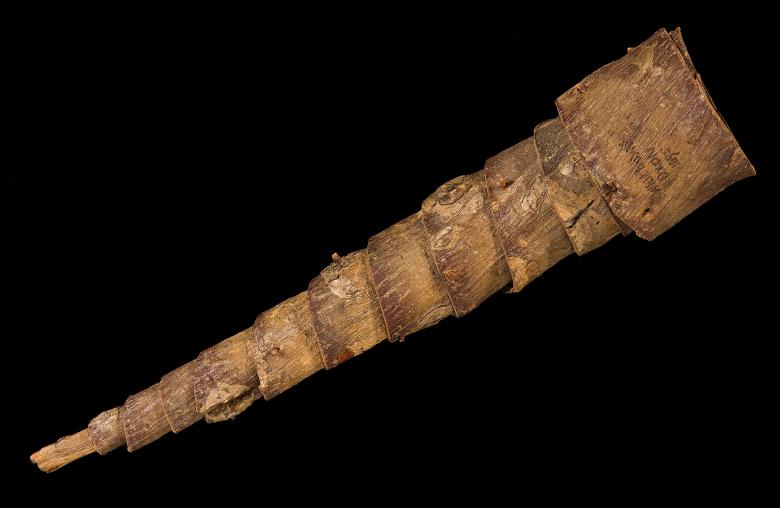
The Whit-Horn

1895.21.1 Whit-horn of willowbark, primitive oboe
In the first half of the nineteenth century it was traditional for the Oxfordshire villages of Hailey, Crawley and Witney to celebrate Whit Monday with a hunt at Wychwood Forest. Whit-horns were made of softened willow bark in the weeks leading up to the celebrations, and played at dawn to wake the village for the hunt.
Formed from strips of willow bark wound into a funnel, the horns were secured with hawthorn or blackthorn spines, the whole measuring around 18" in length and 4" across the bell. Bark was inserted into the narrow end to form a reed, with the mouthpiece pinched together around it, hence Henry Balfour, the first Curator of the Pitt Rivers Collection, described the entire as a 'primitive oboe'.
Describing the traditions surrounding the Whit hunt in Oxfordshire, Balfour wrote,
In accordance with an old charter, certain villages in Oxfordshire were allowed on Whit-Monday to kill a stag in the forest preserves [and feast on their prey. Prior to this, young people] were busy preparing rude instruments of music (or rather of noise), with which to call the villagers to the hunt... they ran round the villages waking people up with the sound of their "whit-horns," as they were called. [1896:221]
The whit-horns in the Pitt Rivers collection (1895.21.1, 1903.130.22.1 and 1903.130.22.2) were donated by Henry Balfour, but were collected by Thomas Carter. They were made in the 1890s - half a century after the last Whit hunt (at the enclosure of the forests). Their maker was an anonymous local man, who had made similar instruments for the hunt in his youth. Percy Manning, a contemporary and probably acquaintance of Balfour's, also collected a whit-horn, which was made for him by John Fisher in 1895. It is likely that he shared his contacts with Balfour and that Balfour's instruments were made by the same man.


This article extract is from England: The Other Within - Analysing the English Collections at the Pitt Rivers Museum project website.
Alice Little

Wednesday, 5 February 2014

Cataloguing Hildburgh’s amulets

W. L. Hildburgh. Image: V&A
Walter Leo Hildburgh was a prolific collector of amulets from all over the world. When he died in 1955, he left his collection to the Wellcome Museum, and from there it was transferred in 1985 - along with thousands of other amulets including those collected by Lovett and de Mortillet - to the Pitt Rivers Museum.

The Wellcome Collection in London is currently engaged in a major revamp, and their new Reading Room will have fresh display spaces, for which they want to loan a number of the amulets now in Pitt Rivers. Some of the Wellcome staff visited Oxford recently and made a selection from the Hildburgh, Lovett and de Mortillet collections. While Lovett and de Mortillet have been the subjects of recent documentation projects, much of the Hildburgh collection remains uncatalogued. It was my task therefore, over the course of a three-month project, to ensure that the documentation for the selected objects was up-to-date, and that a digital image was provided for each.

Amulet for animals
© Pitt Rivers Museum, 1985.53.409
I started by completing the documentation of the Japanese section of the collection, which had already been started by two of my colleagues. From 1900, Hildburgh began a prolonged tour of Japan, India and China. He had a keen interest in anthropology and folklore - particularly magic and superstition. Many of the Japanese amulets are papers, printed with inscriptions and sometimes pictures, which you can buy at Shinto shrines and Japanese Buddhist temples. They can be for protection from various aliments, good luck, or for averting a particular calamity. Animals don’t have to go without protection, either: this amulet, from Hase-dera Temple in Kamakura, is for cows and horses.

Other amulets take the form of objects. They can be natural objects which are ascribed magic or amuletic properties, or they can be figures of deities or animals associated with good luck. One of these, the ‘maneki-neko’, the beckoning cat, is well-known outside Japan and can often be seen enticing customers to enter a Japanese restaurant. It does not bring luck exclusively to business owners, but to anyone who owns such a figurine. 

Maneki-neko and pig amulets
© Pitt Rivers Museum 1985.53.696 and 1985.50.154

Around 20 of Hildburgh’s Japanese amulets are going on display at the Wellcome Collection. To these are added some examples from Italy, Tunisia and Algeria. Amulets from these countries are often meant to be carried on the person for protection and double up as ornaments, e.g. pendants and brooches. This mother-of-pearl pig from Italy is a particularly pretty example. In his ‘Notes on Amulets’, Hildburgh writes that the pig stands for tranquility, an easy life and ‘all desired’.

Amulets are a particularly fascinating and pleasing subject. They are usually small, often beautiful, and come from all over the world, with interesting tales behind them. My project was only a very short one, and whilst I was able to complete the documentation of the Japanese section alone, much of Hildburgh’s collection awaits future projects to uncover the rest of its stories.


Elin Bornemann

Wednesday, 29 February 2012

Magic Snakes and Potatoes


A couple of weeks ago, the project team walked the short distance up to No. 61 Banbury Road, home of the University’s Institute of Social and Cultural Anthropology (ISCA). We went to attend a student lecture entitled ‘The Self-Management of Misfortune by the Use of Amulets and Charms'. The speaker was Eric Edwards, whose years as a former gallery attendant and library assistant at the Museum have endowed him with a passion for, and extensive knowledge of, its collections. 

59 and 61 Banbury Road
© Roger Templeman  

Eric talked about the ancient origins of amulets as far back as Paleolithic Germany more than 30,000 years ago. He pointed out that although concepts of folklore, religion, superstition and medicine were all useful when talking about amulets, the most important thing to understand is that they are believed to possess magical powers. That belief may be personal or cultural (or both), and is what transforms them from ordinary objects into amulets. They retain this power for as long as people believe in them and, in many cases, are only considered efficacious when held, touched or kept close to the body.

PRM 1985.51.840: Ammonite pendant in silver mount
Eric cited the social anthropologist Sir James George Frazer who, a century ago, attributed the magical powers of amulets to one of two principles: the laws of similarity and contagion. Amulets working under the law of similarity use ‘like-for-like’ to imitate cause and effect; for example, in places such as Cambridgeshire and Whitby ammonite fossils were believed to be dead, curled up snakes and were therefore worn as amulets to protect against adder bites. As such, they were often known as ‘adder beads’ and ‘snake stones’.

An amulet working under the law of contagion has once been in contact with another object or person, thereby establishing a magical link between the two. Obvious examples of this type are the many Christian reliquaries we are finding in the de Mortillet collection, their owners able to channel reassurance and protection from the tiny fragments of bone, hair or clothing derived from the saint or holy figure to whom they directed their prayers.

PRM 1908.11.1:
'Lucky stone', Newbiggin-by-the-Sea, Northumberland
Eric went on to describe other idiosyncratic examples of British and Irish amulets. There were twigs of wormwood, fixed over doors to keep away 'bad fairies' in County Cork and the Newbiggin stone, one of the few items in the Museum from Northumberland. It is a piece of limestone that has been bored through naturally by a mollusc and was hung on the back of a door in the cottage of William Twizel, a fisherman, as a ‘lucky stone’. 

Finally, there was a potato charm belonging to Harry Hopkins, an innkeeper in Leighton Buzzard in the late 19th century. Mr Hopkins had carried the potato in his coat pocket along with three others for nine years as a cure for rheumatism and had remained free from the condition for all that time. Unfortunately, you won't be able to use those hash browns in your freezer to the same effect; for the charm to work, it was essential for the potato to have been stolen…


Helen