Showing posts with label religion. Show all posts

Tuesday, 19 May 2015

French Connection: Amulet loan to Marseille

The Pitt Rivers Museum often loans objects to other museums, both in the UK and abroad. During transit, installation and removal, a member of Pitt Rivers Museum staff is present making sure the objects are looked after. The Musée des Civilisations de l’Europe et de la Méditerranée (MuCEM) in Marseille has a temporary exhibition entitled Lieux Saints Partagés ('Shared Sacred Sites'). Staff from MuCEM came to the PRM to select candidates objects in summer 2014 and earlier this month I couriered the loan of 14 amulets to Marseille.


MuCEM © Pitt Rivers Museum

The amulets were checked and prepared by Kate Jackson, Conservator at the PRM. Kate took photographs and recorded the condition of the objects before their journey, then mounts were made to keep the fragile object secure in transit as they were packed into a small carry case. I flew to Marseille and the carry case was secured in the aeroplane seat next to me.

The amulets being checked and then installed in the display case. © Pitt Rivers Museum

At MuCEM the other objects and art works of the exhibition were also being installed - objects exploring the nature of holy sites of shared significance among different religions around the Mediterranean.

The loaned amulets derive from Jewish, Christian and Muslim traditions, made in continental Europe, north Africa and the near East. They are all part of a large collection made by Adrien de Mortillet, which was the focus of our recent Small Blessings project.

Twelve of the Pitt Rivers amulets were put in a display case together. The other two were displayed in a case with other objects from the Milk Grotto in Bethlehem. These two circular tablets are made of white clay. One side is impressed with a geometric motif, the other side shows a feint figure of the Virgin Mary holding the baby Jesus.


Milk Grotto tablets, Palestine. PRM 1985.52.938 © Pitt Rivers Museum

According to legend, Mary was nursing baby Jesus in the grotto when a drop of milk spilled onto the ground and turned it white. This miracle led to the belief that dust and clay from the grotto, which is made of limestone, can enhance fertility and improve a motherʼs milk. Although tablets of clay like these ones are no longer sold, the Franciscans who oversee the shrine still prepare small packets of limestone powder to give in return for a small donation. They instruct that both husband and wife should drink the powder mixed with milk or water for nine days, and recite the prayer for the Third Joyful Mystery of the Rosary which recalls the birth of Jesus, known as the Nativity.

Milk Grotto display © Pitt Rivers Museum

MuCEM was built for 2013 when Marseille was European Capital of Culture. Marseille is a historic port city and a modern meeting place for Mediterranean cultures which makes it an entirely appropriate place for an exhibition such as this. The exhibition is on until 31 August 2015.

MuCEM and Fort Saint-Jean. © Pitt Rivers Museum

Madeleine Ding
Curatorial Assistant and Volunteers Officer


Wednesday, 29 February 2012

Magic Snakes and Potatoes


A couple of weeks ago, the project team walked the short distance up to No. 61 Banbury Road, home of the University’s Institute of Social and Cultural Anthropology (ISCA). We went to attend a student lecture entitled ‘The Self-Management of Misfortune by the Use of Amulets and Charms'. The speaker was Eric Edwards, whose years as a former gallery attendant and library assistant at the Museum have endowed him with a passion for, and extensive knowledge of, its collections. 

59 and 61 Banbury Road
© Roger Templeman  

Eric talked about the ancient origins of amulets as far back as Paleolithic Germany more than 30,000 years ago. He pointed out that although concepts of folklore, religion, superstition and medicine were all useful when talking about amulets, the most important thing to understand is that they are believed to possess magical powers. That belief may be personal or cultural (or both), and is what transforms them from ordinary objects into amulets. They retain this power for as long as people believe in them and, in many cases, are only considered efficacious when held, touched or kept close to the body.

PRM 1985.51.840: Ammonite pendant in silver mount
Eric cited the social anthropologist Sir James George Frazer who, a century ago, attributed the magical powers of amulets to one of two principles: the laws of similarity and contagion. Amulets working under the law of similarity use ‘like-for-like’ to imitate cause and effect; for example, in places such as Cambridgeshire and Whitby ammonite fossils were believed to be dead, curled up snakes and were therefore worn as amulets to protect against adder bites. As such, they were often known as ‘adder beads’ and ‘snake stones’.

An amulet working under the law of contagion has once been in contact with another object or person, thereby establishing a magical link between the two. Obvious examples of this type are the many Christian reliquaries we are finding in the de Mortillet collection, their owners able to channel reassurance and protection from the tiny fragments of bone, hair or clothing derived from the saint or holy figure to whom they directed their prayers.
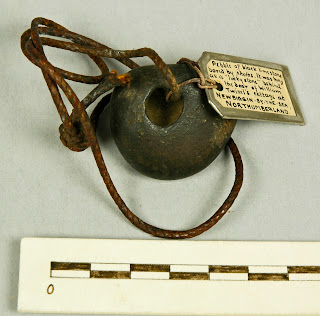
PRM 1908.11.1:
'Lucky stone', Newbiggin-by-the-Sea, Northumberland
Eric went on to describe other idiosyncratic examples of British and Irish amulets. There were twigs of wormwood, fixed over doors to keep away 'bad fairies' in County Cork and the Newbiggin stone, one of the few items in the Museum from Northumberland. It is a piece of limestone that has been bored through naturally by a mollusc and was hung on the back of a door in the cottage of William Twizel, a fisherman, as a ‘lucky stone’. 

Finally, there was a potato charm belonging to Harry Hopkins, an innkeeper in Leighton Buzzard in the late 19th century. Mr Hopkins had carried the potato in his coat pocket along with three others for nine years as a cure for rheumatism and had remained free from the condition for all that time. Unfortunately, you won't be able to use those hash browns in your freezer to the same effect; for the charm to work, it was essential for the potato to have been stolen…


Helen