Showing posts with label magic. Show all posts

Monday, 16 November 2015

A Dorset Hag Stone

1884.56.3 is an object, described by a museum worker as a 'stone with natural perforation, found fixed on a nail to the cottage-door of Kimber, a carter in General Pitt Rivers' employment, to keep away witches'. This is particularly interesting as it must have been acquired between 1880, when Pitt Rivers first inherited the Rushmore estate, and 5 April 1881 when he sent the stone to South Kensington Museum (where his collection was then displayed).
PRM 1884.56.3


The documentation held at the Museum states:
Accession Book IV entry - 1884.56.1 - 100 Charms Magic etc. - Naturally perforated stone, nailed to a cottage door against witches by a carter Rushmore nr Salisbury
'Green book' entry - South Kensington Receipts, 5 April 1881 - Collection of objects as per list attached nos 293 to 639 540 Holed stone used for the purpose of keeping away witches Rushmore nr Salisbury

Detailed Amulet card catalogue entry - Amulets ) O. Inscribed P. Talismans in cases Q Uninscribed single R Collars, necklets, armlets, rings S-T Juju [sic] U-W Stone X. Dance Y. Unclassed. - Naturally perforated stones Gt Britain Description: Stone with natural perforation, found fixed on a nail to the cottage-door of Kimber, a carter in Gen'l Pitt Rivers' employment, to keep away witches. Dimensions 100 x 64 approx Locality: Rushmore nr Salisbury How Acquired: P.R. coll 540 / 12191
The original documentation does not mention the name of the carter and it is not clear where the information came from, it first appears in the Ettlinger account, she thanks the then curator of the Museum, Tom Penniman, for information so he may have given her the reference, it is irritating that it was not recorded where it was obtained, as that source might have more information about the artefact.

This article extract is from England: The Other Within - Analysing the English Collections at the Pitt Rivers Museum project website.

Alison Petch, 

Researcher

Tuesday, 18 August 2015

A Fisherman’s ‘Lucky stone’ from Newbiggin-by-the-Sea, Northumberland

PRM 1908.11.1


Introduction

At the front of the Sympathetic Magic display at the Pitt Rivers Museum, case 61a, is a perforated black limestone beach pebble with a string attached through the hole. [1908.11.1] The museum’s accession book states that this is a “Beach pebble of black limestone bored by pholas, hung behind a door in the cottage of William Twizel, fisherman, as a “lucky stone”.’ (Humble, 1908). Apparently several of these stones hung by various doors of the cottage. The stone comes from Newbiggin-by-the-Sea, Northumberland, and was donated in 1908 by a Miss Humble, Alexander James Montgomerie Bell, and William Twizel (actually Twizzell) in 1908.
There is no mention of a William Twizel in the 1901 census. However, there several William Twizzells (various spellings) in Newbiggin, one being born in 1822 and who died a retired fisherman in 1913. The most likely donor is a William Twizzell who was born circa 1829/1830 and who died a retired fisherman in 1909.

The Donors

Miss Humble is described as a field collector but little else is known about her. Accession records in the PRM say she was a resident of Newbiggin. However, the name is fairly common in the north-east and it was not possible to identify her in either the 1891 or 1901 censuses (england.prm.ox.ac.uk/collector).

Much more is known about Alexander James Montgomerie Bell. Born in Edinburgh in 1846 he was an undergraduate at Balliol and matriculated as an Exhibitioner in 1864, gained his BA in 1869 and took his MA in 1871 (Oxford University Alumni 1500-1886). The obituary of Bell describes him as a career academic, teacher, antiquarian, and amateur archaeologist. He worked sometimes as a tutor and had more formal roles as a schoolmaster (Marlborough, Fettes) and college lecturer and examiner (St Johns, Worcester). Alexander Bell was also known for his work and research on the Wolvercote gravels and deposits near Oxford (Nature, 1920). He died in 1920 aged 74 and his artefact collection was sold to the Pitt Rivers Museum. Alexander Bell lived in 1891 with his wife Anna and children Archibald, Evelyn, Mary, and William at Rawlinson Road in Oxford. At this period he was engaged in private tutoring in classics, geography and geology (RG12a. 1166. 87.). The family was still there in 1901 when Alexander held a position of private tutor at a public school (RG13. 1381. 35.). Indeed, Alexander’s son Archibald Colquhoun Bell (born 1886), and who had a long naval career, also became a donor to the PRM around 1920 (england.prm.ox.ac.uk/collector).

The folklore of holed stones

The Newbiggin stone “…a pebble of black limestone, bored by a pholas, was hung behind the door of William Twizel’s cottage…” (Ettlinger, 1943). Such holed stones were “…evidently regarded as magical as early as the second millennium B.C., as shown by the excavations at Tell el Ajjul (ancient Gaza)…” (Murray, 1943). As such these stones were deliberately placed with three in a room and one in a grave.

The hole in the Newbiggin stone was made by a burrowing bivalve mollusc called Pholas dactylus. Also known as the ‘Common Piddock’ or ‘angelwing’ it is similar to a clam and bores into a range of soft rock sub-strata including chalk, peat, clay, and sandstone. This elliptical shaped boring bivalve, which can reach 12cm in length, is found at several sites along the east coasts of Northumbria and Yorkshire. It stays in its burrow for its entire eight-year life-span, it is recognised by its typical whitish colouration and is also known for its bio-luminescence.
This article extract is from England: The Other Within - Analysing the English Collections at the Pitt Rivers Museum project website.

Eric Edwards


Thursday, 10 May 2012

My lucky cork


Last summer I was given this little object by my PhD supervisor. As he handed it to me he noticed a puzzled expression on my face. The object, a champagne cork and pound coin, was one that I had not encountered before.

In fact, the practice of placing a coin in a champagne cork has a long tradition. Corks that have been popped on special occasions, at weddings, birthday parties, or in this case my PhD viva (the examination of my doctoral thesis), have been made into keepsakes and good luck charms by many people. 

They were also once used by fishermen, who would cut a slit in the cork floats on their nets and insert a coin to pay for their catch. This one now sits on a shelf in my office, where I hope it will work a little lucky magic. 

I hope you will share your own lucky objects with us by entering the Amulets Around The World Today photograph competition, which runs from 10 May to 31 July 2012.


Charlotte

It's a Kind of Magic

This week, a guest blog from Simone Dogherty, an Education Officer at the Museum.

A family enjoying the Make-and-Take activity after exploring the handling objects

On the first Saturday of every month, the Education team delivers free, family-friendly, drop-in activities. This month, we ran one in conjunction with the Small Blessings project, called ‘It’s a Kind of Magic’. We had a range of activities on offer during the afternoon to get families interacting with the charms and amulets on display in the Museum. There was a trail, called ‘Charm Challenge’, which guided families around specific objects in the amulet displays and encouraged children to design their own. There was also a handling table, where families could hold real Museum objects and discuss them with trained volunteers. Finally – the biggest attraction – a ‘Make-and-Take’ activity, where families could decorate a charm bracelet or armband, and hang from it paper charms based on real ones in the collection. 

Making paper charms for armbands to take home


This Make-and-Take was a nicely straightforward activity to create. Charms and amulets naturally lend themselves to being worn, or carried around with you, so making a bracelet or armband seemed an obvious choice. It’s always nice to have a strong connection between the objects and an activity, to ensure that the families also get a valuable educational experience out of it, often without realizing. Also, the most successful Make-and-Takes are always those where the children (and adults!) get to wear what they make.

This boy had designed many of his own charms,
including one to help things grow in his garden

A pretty charm bracelet, each one's magical powers described on the back

There’s always preparation for an event like this. You have to create and present the activity and trail in a way that enables families to learn a lot without much effort, as well as make them fun and enjoyable so they have a positive experience in the Museum. It’s a difficult balance to strike, so a lot of time is devoted to this. Then there’s all the photocopying, laminating, and setting up the activity space. On the day, a huge amount of work is done by a wonderful team of volunteers who assist families, run the handling tables and promote the other activities going on, so I get the opportunity to step back and check that it all runs smoothly!

We had lots of positive feedback and, even better, lots of families were keen to head downstairs to see the amulet displays and learn a bit more about them. More than 100 children participated in the activities, which hopefully reflects the large number of people inspired by the collections, and who discovered new things about charms and amulets from around the world!


Simone


Wednesday, 29 February 2012

Magic Snakes and Potatoes


A couple of weeks ago, the project team walked the short distance up to No. 61 Banbury Road, home of the University’s Institute of Social and Cultural Anthropology (ISCA). We went to attend a student lecture entitled ‘The Self-Management of Misfortune by the Use of Amulets and Charms'. The speaker was Eric Edwards, whose years as a former gallery attendant and library assistant at the Museum have endowed him with a passion for, and extensive knowledge of, its collections. 

59 and 61 Banbury Road
© Roger Templeman  

Eric talked about the ancient origins of amulets as far back as Paleolithic Germany more than 30,000 years ago. He pointed out that although concepts of folklore, religion, superstition and medicine were all useful when talking about amulets, the most important thing to understand is that they are believed to possess magical powers. That belief may be personal or cultural (or both), and is what transforms them from ordinary objects into amulets. They retain this power for as long as people believe in them and, in many cases, are only considered efficacious when held, touched or kept close to the body.

PRM 1985.51.840: Ammonite pendant in silver mount
Eric cited the social anthropologist Sir James George Frazer who, a century ago, attributed the magical powers of amulets to one of two principles: the laws of similarity and contagion. Amulets working under the law of similarity use ‘like-for-like’ to imitate cause and effect; for example, in places such as Cambridgeshire and Whitby ammonite fossils were believed to be dead, curled up snakes and were therefore worn as amulets to protect against adder bites. As such, they were often known as ‘adder beads’ and ‘snake stones’.

An amulet working under the law of contagion has once been in contact with another object or person, thereby establishing a magical link between the two. Obvious examples of this type are the many Christian reliquaries we are finding in the de Mortillet collection, their owners able to channel reassurance and protection from the tiny fragments of bone, hair or clothing derived from the saint or holy figure to whom they directed their prayers.
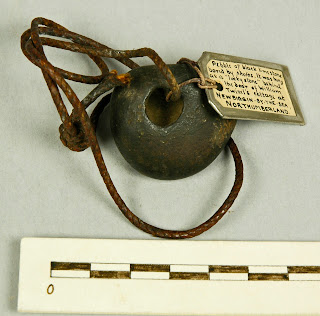
PRM 1908.11.1:
'Lucky stone', Newbiggin-by-the-Sea, Northumberland
Eric went on to describe other idiosyncratic examples of British and Irish amulets. There were twigs of wormwood, fixed over doors to keep away 'bad fairies' in County Cork and the Newbiggin stone, one of the few items in the Museum from Northumberland. It is a piece of limestone that has been bored through naturally by a mollusc and was hung on the back of a door in the cottage of William Twizel, a fisherman, as a ‘lucky stone’. 

Finally, there was a potato charm belonging to Harry Hopkins, an innkeeper in Leighton Buzzard in the late 19th century. Mr Hopkins had carried the potato in his coat pocket along with three others for nine years as a cure for rheumatism and had remained free from the condition for all that time. Unfortunately, you won't be able to use those hash browns in your freezer to the same effect; for the charm to work, it was essential for the potato to have been stolen…


Helen